
Engineering Simulation: The Architect of Sustainability
The global imperative for sustainable development and the net-zero challenge. But Innovation often requires rapid prototyping, which can be resource-intensive and wasteful. The Solution is Engineering Simulation (CAE/FEM/CFD) as the critical, invisible tool transforming sustainable design.
PRODUCT DEVELOPMENTSUSTAINABLE DESIGNGREEN ENGINEERINGFUTURE OF ENGINEERINGENGINEERING SIMULATION
7/5/20262 min read
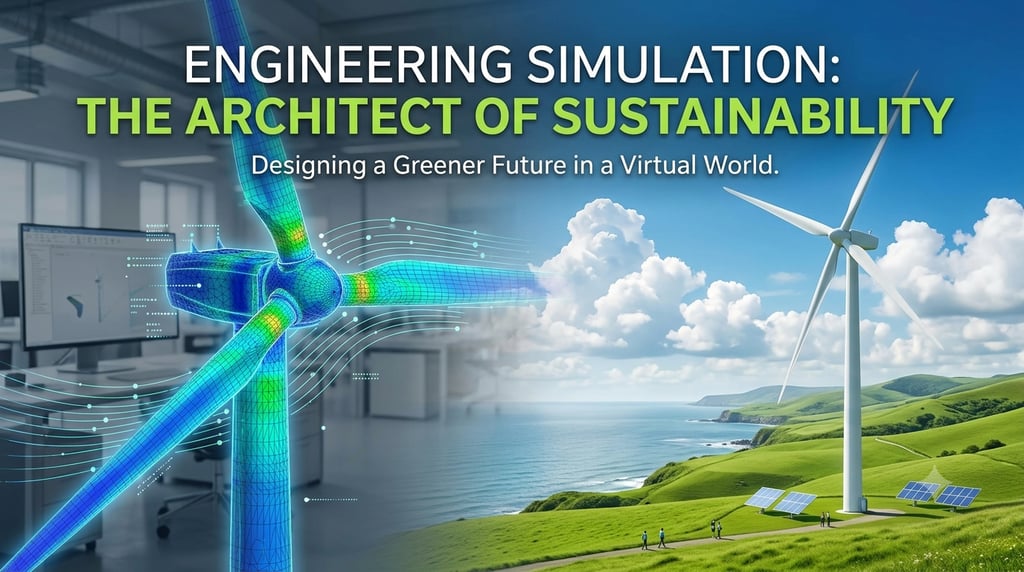
The global push toward net-zero emissions has fundamentally altered how we approach industrial design and manufacturing. Traditionally, innovation has been a material-intensive process, relying on a cycle of trial and error where physical prototypes are built, tested to failure, and discarded. This approach carries a heavy environmental footprint. Engineering simulation—spanning Finite Element Analysis (FEA), Computational Fluid Dynamics (CFD), and electromagnetic modeling—offers a powerful alternative by shifting this entire iterative process into a virtual environment. By building a digital proving ground, engineers can evaluate thousands of design variations under extreme operating conditions without wasting a single ounce of raw material or consuming manufacturing energy.
Beyond reducing prototyping waste, virtual testing is a primary driver of operational efficiency and material dematerialization. Through advanced techniques like topology optimization, simulation software analyzes stress distribution and strips away unnecessary mass from components, resulting in lighter products that require fewer resources to produce and less energy to transport. In fluid-heavy applications, CFD allows designers to meticulously map airflow and thermal distribution. This capability is vital for optimizing everything from the aerodynamic drag of electric vehicles to the passive heating and cooling efficiency of large-scale architecture, ensuring that systems use minimal power once deployed.
To understand the tangible impact of these virtual workflows, consider the typical metrics achieved across key industrial design and sustainability benchmarks:
Material and Mass Reduction (Dematerialization): By utilizing topology optimization and structural simulation, engineers can remove excess material from structural components without sacrificing safety.
Typical Savings: 15% to 40% reduction in total component weight.
Environmental Impact: Direct reduction in raw material extraction (aluminum, steel, composites) and lower carbon emissions during product transportation.
Prototyping Waste Mitigation: Moving from physical "build-and-break" cycles to a virtual environment dramatically alters the development lifecycle.
Typical Savings: 60% to 80% fewer physical prototypes required during R&D.
Environmental Impact: Eliminates tons of scrap material, specialized tooling waste, and the physical energy consumed by operating physical test rigs.
Operational Energy Efficiency: Simulating fluid dynamics and thermal management directly translates to less energy consumed during a product's active lifespan.
Typical Savings: 10% to 25% reduction in aerodynamic drag for transport vehicles, and up to 30% improvement in thermal efficiency for HVAC and industrial cooling systems.
Environmental Impact: A permanent decrease in operational energy demands, lowering greenhouse gas emissions throughout the product's multi-year life cycle.
This digital approach is already proving indispensable across the clean energy sector. When designing massive offshore wind turbines, engineers use structural and fluid simulations to optimize blade geometry for maximum energy capture while ensuring the structures can withstand violent oceanic storms. Similarly, in the automotive industry, thermal simulation plays a decisive role in engineering battery packs that manage heat effectively, extending the range and operational lifespan of electric vehicles. As these software tools evolve into real-time "digital twins"—virtual replicas that constantly sync with physical assets to predict maintenance needs and optimize performance—engineering simulation is transitioning from a mere cost-saving tool into an absolute prerequisite for building a resilient, sustainable global infrastructure.

Gofinite Ventures LLP
LLPIN : AAU-5144